


Summarize with AI


Z.ai has released GLM-5.4, its first flagship model built on a Loop Transformer architecture. The model is available on November 23, 2026 in the GLM Coding Plan, ZCode, and Z.ai Chat, with model weights and broader API access planned after safety evaluations.
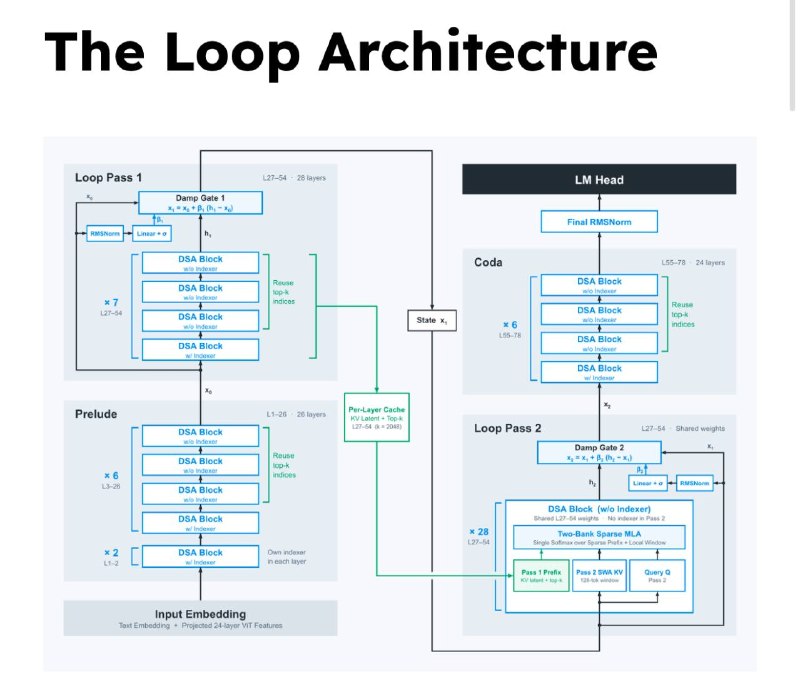
Instead of adding more parameters, GLM-5.4 adapts the 750B GLM-5 base model by running 28 middle layers twice with shared weights. Z.ai states that this extra iteration raises reasoning performance to levels comparable to 2T to 3T parameter models while keeping the base parameter count fixed.
What it is
- Looped middle layers: Rather than training from scratch, Z.ai converted the pre-trained GLM-5 model via continued training so 28 layers run for two passes per forward pass.
- Efficiency modifications: GLM-5.4 uses per-token progressive gating to stabilize activations, a hybrid KV cache that pairs cross-loop sparse KV sharing with a local sliding window, and sparse attention index reuse.
- Context and modalities: The model supports a 1M token context window, up to 128K output tokens, and inputs spanning text, files, images, and video.
- Throughput and limits: Z.ai reports off-peak speeds up to 200 tokens per second and 70 to 80 tokens per second at peak load, while noting that Thinking Mode can sometimes enter overly long "marathon thinking" loops.
Benchmark results (30B ablation)
Full 750B benchmark tables have not been published yet. In a controlled iso-parameter test on a 30B model using the same architecture (~10% extra training compute, 200K long-context SFT, thinking mode enabled), looping improved scores while shortening average responses:
| Benchmark | Baseline | + Loop | Improvement | Output length change |
|---|---|---|---|---|
| AIME25 | 19.17 | 30.42 | +11.3 | -635 tokens (-2%) |
| GPQA-Diamond | 47.58 | 56.26 | +8.7 | -2,473 tokens (-11.7%) |
| AA-LCR | 40.33 | 47.67 | +7.3 | -539 tokens (-9.7%) |
| MMLU-Pro | 71.65 | 75.05 | +3.4 | -863 tokens (-14.9%) |
| IFBench | 50.20 | 53.47 | +3.3 | -763 tokens (-13.0%) |
Sources
Did this land? Leave a reaction.
Discussion
0 commentsMembers can join the discussion
Become a member to comment and reply to other members.
Become a MemberNo comments yet
Be the first to start the discussion.