


Summarize with AI


Researchers from Stanford University and NVIDIA Research have released CLM-8B, an open model that picks an AI agent's next action instead of writing text. The weights are on Hugging Face and the code is on GitHub, both under Apache 2.0.
The team announced Contrastive Language Models (CLMs) on September 23, 2026, and called them "a new class of System One model". CLM-8B is the first released model. It is an open alternative to Jev, the "System One" model that TypeSafe AI launched on September 15, 2026. TypeSafe founder Diogo Almeida previously worked at OpenAI on the research behind ChatGPT. Jev returns typed decisions with calibrated probabilities and costs $0.042 per million input tokens.
What it is
- Job. The model gets the current state and a set of candidate actions, and returns a probability for each action.
- Question types. It answers three kinds of typed questions: whether a statement is true (
Noul), which option to pick (Choice) and where something falls on an ordered scale (Score). - Verifier. A fine-tuned CLM can act as a verifier that picks the best of several candidate solutions from a coding agent.
- No text. CLM does not generate text. It only scores the candidates it is given, and its probabilities are relative to that set.
- Architecture. A frozen Qwen3-8B encoder with two small trainable projection heads: one for the state and one for the action. Each head has 20M parameters.
- How it scores. States and actions are encoded separately. The model compares their vectors and turns the similarity into probabilities with a softmax.
- Caching. Action vectors do not change, so they can be computed once and reused. This makes repeated decisions faster.
- Training. Pre-trained on about 60M Nemotron Q&A pairs, mid-trained on about 30M synthetic hard negatives and post-trained on about 1M agent trajectories.
- API. The server exposes a TypeSafe-compatible API, so a request written for Jev can be replayed against CLM.
- Running it. Install with
pip install contrastive-lm. It needs Qwen3-8B served as an embedding model through vLLM on a GPU, plus theclm-serveAPI server.
Price
| Model | Access | Price |
|---|---|---|
| CLM-8B | Open weights, Apache 2.0, self-hosted | Free (you pay for your own GPU) |
| Jev (TypeSafe AI) | API, early access | $0.042 per million input tokens, output free |
Results
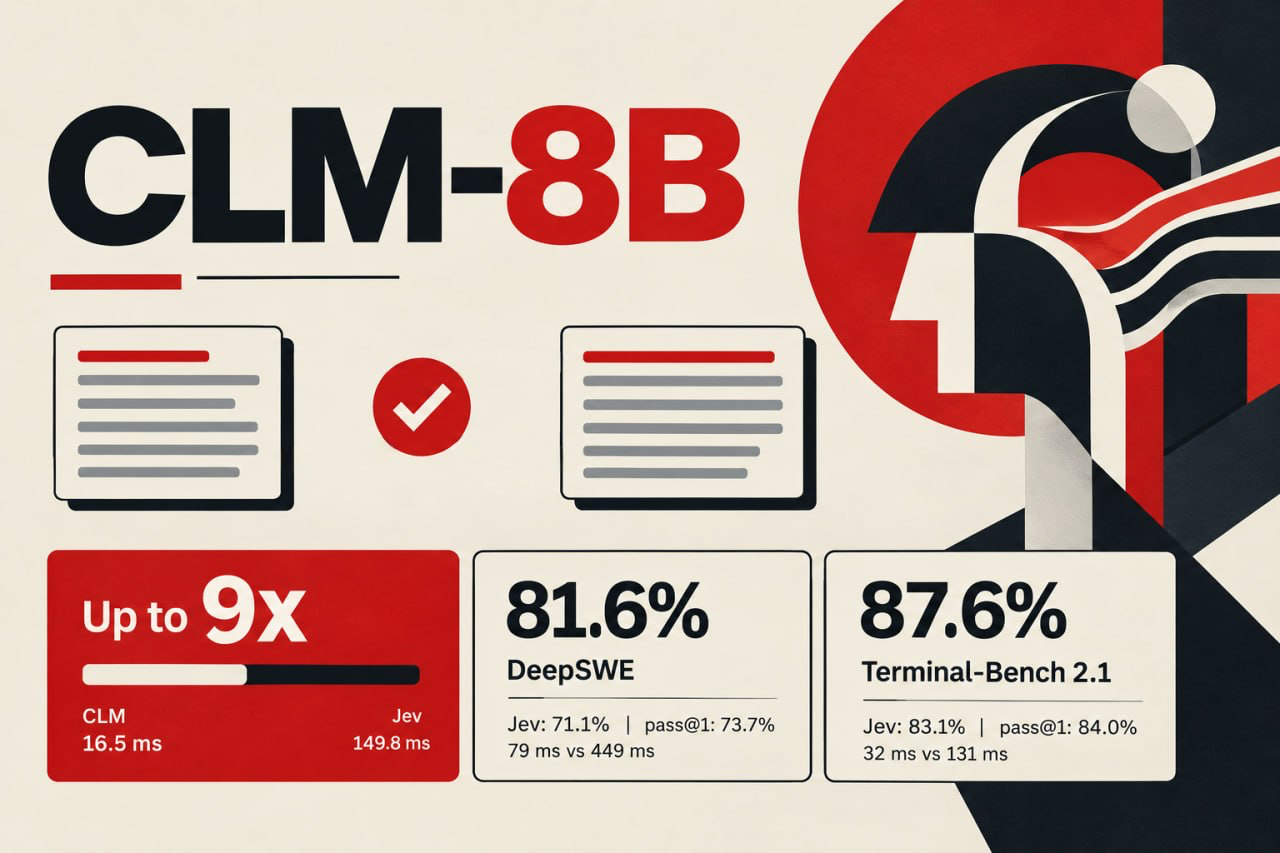
Without fine-tuning, CLM-8B performs on par with Jev on computer-use, gaming and tool-calling tasks and runs up to 9x faster. With about 1,000 candidate actions and cached vectors, the model card says CLM is 13x faster than Jev.
| Task | CLM-8B latency | Jev latency | CLM-8B success | Jev success |
|---|---|---|---|---|
| T-Rex game | 16.5 ms | 149.8 ms | 5/5 | 5/5 |
| Tool calling (BFCL V4) | 76.8 ms | 125.5 ms | 95.2% | 99.2% |
| WikiRacing | 79.8 ms | 225 ms | 26/30 | 30/30 |
| Super Mario | 33.5 ms | 132.6 ms | 5/5 | 5/5 |
As a verifier, the team fine-tuned CLM and let it pick the best of several candidate solutions. The test used 38 held-out DeepSWE tasks (best of 4) and 30 held-out Terminal-Bench 2.1 tasks (best of 5), with latency measured on an H100. Jev in the same role scored below a single attempt (pass@1).
| Benchmark | Pass@1 | CLM (fine-tuned) | Jev | Latency CLM vs Jev |
|---|---|---|---|---|
| DeepSWE | 73.7% | 81.6% | 71.1% | 79 ms vs 449 ms |
| Terminal-Bench 2.1 | 84.0% | 87.6% | 83.1% | 32 ms vs 131 ms |
The 81.6% DeepSWE score is 31 of 38 tasks. The model card notes these verifier results come from fine-tuned heads, not the released checkpoint used zero-shot.
Sources
Did this land? Leave a reaction.
Discussion
0 commentsMembers can join the discussion
Become a member to comment and reply to other members.
Become a MemberNo comments yet
Be the first to start the discussion.