
Summarize with AI


OpenAI announced that its AI reasoning systems generated formal mathematical proofs and theoretical physics solutions for open problems that remained unresolved by human researchers for decades.
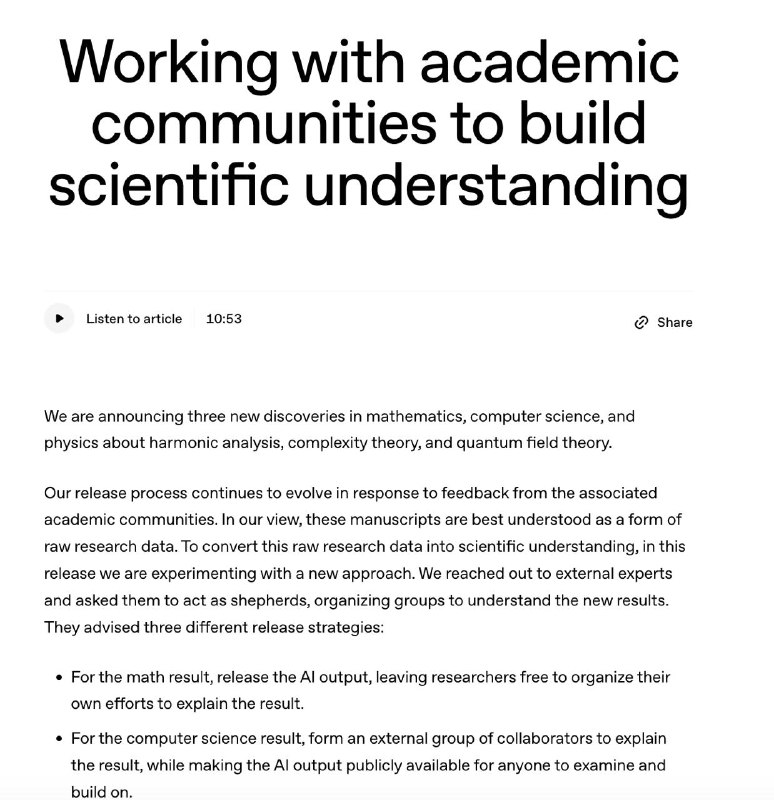
The discoveries span harmonic analysis, computational complexity, and theoretical high-energy physics, and are currently undergoing peer review by specialized academic panels.
In mathematics, the model constructed a proof of Christopher Sogge's local smoothing conjecture across spaces of arbitrary dimensions. The proof, which also implies solutions to the Kakeya and Stein conjectures, was formalized in Lean and published.
In computer science, OpenAI's model generated a Lean-verified refutation of the Exponential Time Hypothesis (ETH), a foundational conjecture underpinning complexity assumptions across hundreds of algorithms. The refutation is currently under review by a committee including two of the original authors of the hypothesis.
In physics, the model produced rigorous proofs regarding quantum chromodynamics and four-dimensional pure Yang-Mills theory, which connects to the $1 million Millennium Prize Problem. OpenAI clarified that the finding addresses key theoretical existence properties without representing a full solution to the prize problem. Theoretical materials are under review by a group led by Nobel laureate David Gross.
What it is
- Sogge local smoothing conjecture: Solved for spaces of any dimension, with formal verification published in Lean.
- Exponential Time Hypothesis (ETH): Model discovered a formal counterexample to the complexity assumption, now under academic review.
- Yang-Mills existence: Provided rigorous mathematical frameworks for 4D gauge theories related to the Millennium Prize Problem.
- Lean formal verification: Generated proofs were codified and verified using interactive theorem provers.
Sources
Did this land? Leave a reaction.
Discussion
0 commentsMembers can join the discussion
Become a member to comment and reply to other members.
Become a MemberNo comments yet
Be the first to start the discussion.