


Summarize with AI


Liquid AI has released LiquidCodec, a 74-million-parameter streaming speech codec that converts audio into discrete tokens for language models and reconstructs speech from predicted tokens. Model weights are available on Hugging Face under the LFM Open v1.0 license.
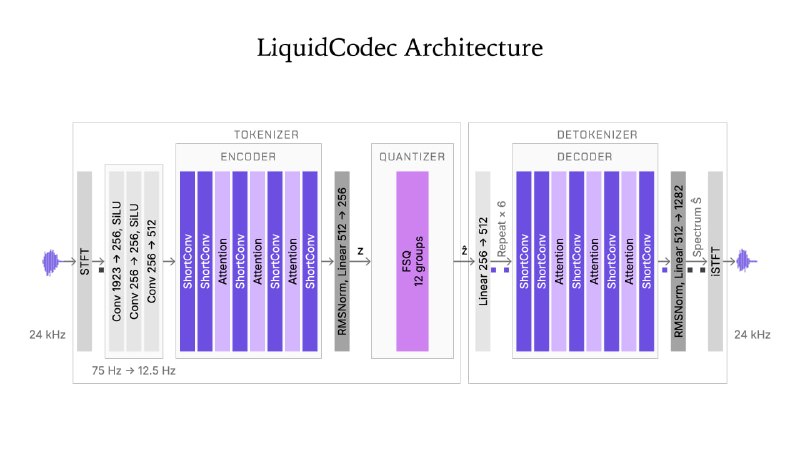
LiquidCodec powers the LFM3-Audio-2B and LFM3-Omni-2B models released in late October and is engineered for fast on-device execution. On a single thread of a MacBook Pro with an M4 Max processor, encoding runs at 361x real-time speed and decoding runs at 87x real-time speed.
What it is
- Streaming causal architecture: LiquidCodec outputs 12.5 frames per second at 24 kHz audio using a strictly causal encoder that looks only at past context for low-latency streaming.
- Parallel codebook prediction: Replacing the residual vector quantization used in the Mimi codec from LFM2-Audio, LiquidCodec uses grouped finite scalar quantization (FSQ) with 12 codebooks that a language model can predict in parallel. The decoder outputs spectral coefficients directly without costly learned upsampling.
- Faster decoding: Decoding one second of audio takes 0.0115 seconds, compared with 0.0329 seconds for Mimi, 0.0379 seconds for X-Codec 2, and 0.2543 seconds for NanoCodec.
- Higher speech quality: On LibriSpeech, LiquidCodec scored 4.319 on ViSQOL, ahead of NanoCodec (4.219), X-Codec 2 (4.119), and Mimi (4.031). It ranked first on ViSQOL and mel-spectrogram distance across all eight evaluation datasets in English, Chinese, German, French, Japanese, and Korean.
- Compact 4-bit option: Speech synthesis models trained on LiquidCodec tokens ranked first for naturalness across all eight datasets and led intelligibility on four. A 4-bit quantized decoder is 3.5 times smaller while keeping ViSQOL at 4.292.
Sources
Did this land? Leave a reaction.
Discussion
0 commentsMembers can join the discussion
Become a member to comment and reply to other members.
Become a MemberNo comments yet
Be the first to start the discussion.