
Summarize with AI


A survey of 12 Harvard faculty members and researchers reveals a growing rift over whether AI-generated mathematical proofs are valuable if humans cannot understand how they work. In response to increasing reliance on automated assistants, several introductory mathematics courses at Harvard have introduced tech-free sessions this fall.
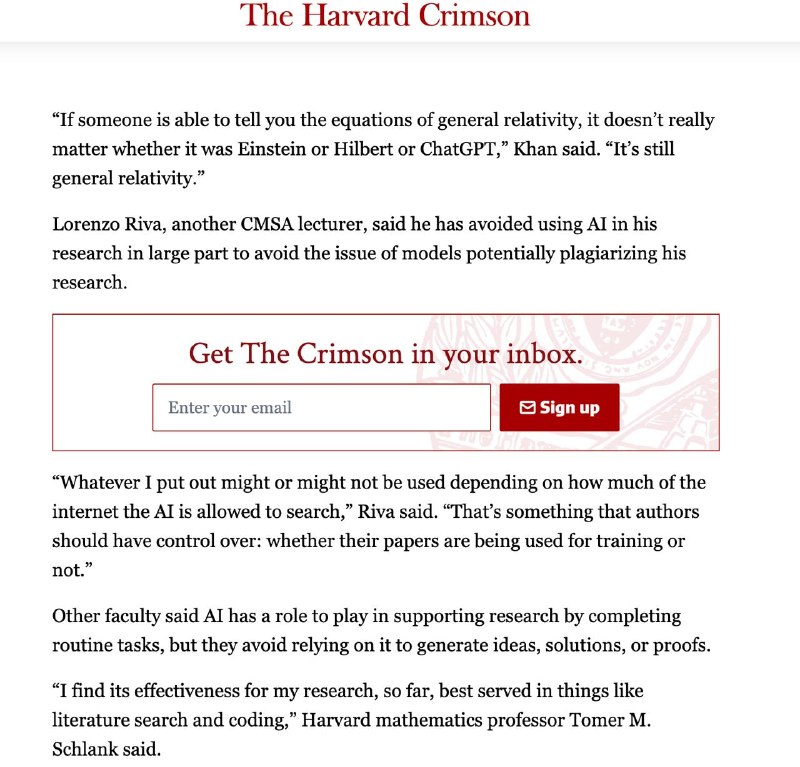
The debate highlights two opposing views in modern mathematics. Some researchers argue that a verified result holds value regardless of whether a machine or human discovered it. Others warn that mathematics loses its purpose when proofs become black boxes that humans cannot comprehend.
Harvard mathematics professor Melanie Matchett Wood emphasized that AI tools should expand human comprehension rather than replace it. Handing problem solving entirely to automated systems risks locking mathematical understanding inside machines. Faculty members also noted practical hurdles with current AI proofs: models often omit explanatory intermediate steps and citations, making verification tedious. Consequently, many researchers limit AI use to literature search and scripting while developing core mathematical arguments by hand.
What it is
- Faculty survey. The Harvard Crimson interviewed 12 mathematics faculty members and researchers on AI's emerging role in mathematical discovery.
- Core divide. Disagreement centers on whether correct answers alone suffice or whether human comprehension of the underlying proof is essential.
- Classroom policy. Introductory Harvard mathematics courses introduced tech-free sessions this fall to ensure students build fundamental reasoning skills.
Sources
Did this land? Leave a reaction.
Discussion
0 commentsMembers can join the discussion
Become a member to comment and reply to other members.
Become a MemberNo comments yet
Be the first to start the discussion.