

Summarize with AI


Google DeepMind and Google Quantum AI used teams of Gemini 4 agents to optimize quantum circuits, cutting simulation costs up to 290x on core building blocks. The research paper and an open-source Lean verification library are now available on arXiv and GitHub.
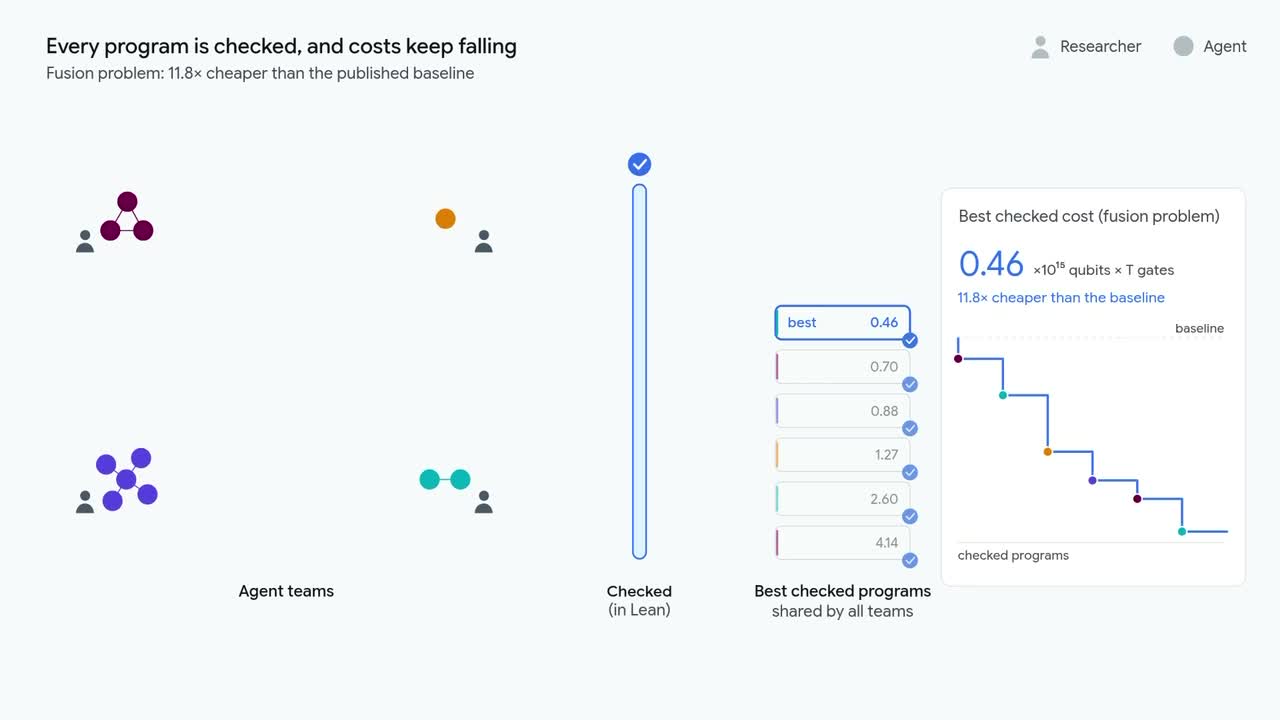
Announced on November 23, 2026, the project targets a major bottleneck in quantum computing: designing smaller, cheaper quantum circuits usually takes years of manual work, and today's quantum hardware is still too small to test large circuits directly. To solve this without physical quantum processors, every optimization proposed by the Gemini 4 agent teams had to be mathematically proven in Lean, a formal theorem prover, before it could enter a shared notebook.
Independent teams of agents worked on specific quantum algorithms and met every four hours in virtual conferences to trade, debate, and compare verified ideas. Running the resulting scientific simulations still demands more resources than the first error-corrected quantum computers are expected to support, so the speedups remain theoretical until larger hardware arrives.
What it is
- Multi-agent formal verification: Independent teams of Gemini 4 agents search for algorithmic circuit improvements and verify every step in Lean to guarantee mathematical correctness.
- Arcsin routine (290x speedup): Accelerated a fundamental arithmetic operation used across many quantum algorithms to load numbers into quantum states.
- Fusion simulation (11.8x cheaper): Reduced the computing cost for modeling inertial confinement fusion, cutting required memory from 5,650 to 4,338 error-corrected qubits.
- Light-sensitive molecule (8x cheaper): Simplified how quantum simulations track particle positions and electric forces in photochemical reactions.
- Grover's algorithm (2.57x speedup): Improved a specific implementation of the foundational quantum search operation.
- Cytochrome P450 enzyme (2.5x improvement): Lowered qubit memory requirements from 481 to 333 qubits for simulating an enzyme involved in breaking down medicines.
- Open-source Lean library: DeepMind published its Lean framework, problem specifications, and verified solutions on GitHub.
Sources
Did this land? Leave a reaction.
Discussion
0 commentsMembers can join the discussion
Become a member to comment and reply to other members.
Become a MemberNo comments yet
Be the first to start the discussion.