


Summarize with AI


Anthropic released findings from an empirical study analyzing 207,049 scientific sessions across Claude and Claude Code alongside survey responses from 528 active research scientists, projecting a potential 15x to 16x expansion in scientific research volume in computational fields.
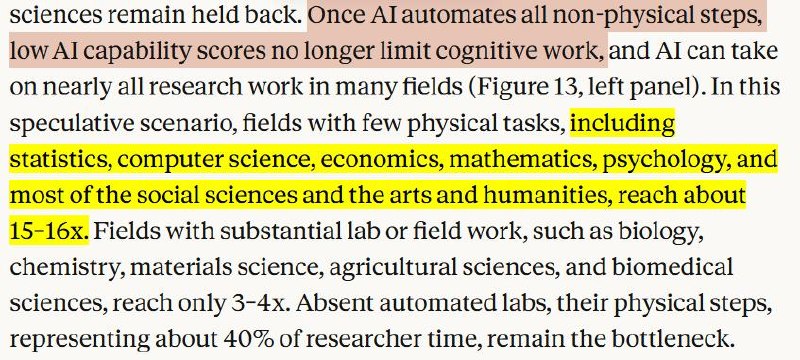
The study highlights a distinct bifurcation between disciplines: while computer science, statistics, and mathematics can automate nearly the full research pipeline, physical sciences like biology and chemistry remain bound to the throughput of wet-lab experiments.
What it is
- Computational acceleration. Full cognitive automation could accelerate research throughput by 15x to 16x in computer science, mathematics, and statistics, compared to an estimated 3x to 4x gain in experimental biology and chemistry.
- Autonomous scientific projects. Nearly 40% of surveyed researchers currently employing AI models expect autonomous agents to execute end-to-end scientific research projects independently by 2030.
- High autonomy in Claude Science. In specialized Claude Science sessions for biology and biomedicine, 73.3% of interactions exhibited high agentic autonomy, compared to only 23.7% in standard consumer Claude chats.
- PhD-level complexity. Anthropic's review classified 82.7% of Claude Science tasks as requiring PhD-level domain expertise.
- Near-term vs long-term horizon. While a 16x boost represents theoretical full cognitive automation, surveyed scientists report actual day-to-day productivity gains of up to 2x with current-generation frontier models.
Discipline comparison
| Scientific Discipline | Theoretical Automation Gain | Primary Limiting Factor |
|---|---|---|
| Computer Science & Math | 15x–16x | Algorithmic verification and compute budget |
| Statistics & Data Science | 15x–16x | Data cleaning and model validation |
| Biology & Biomedicine | 3x–4x | Wet-lab turnaround and physical assays |
| Chemistry & Materials | 3x–4x | Synthesis trials and laboratory safety |
Sources
Did this land? Leave a reaction.
Discussion
0 commentsMembers can join the discussion
Become a member to comment and reply to other members.
Become a MemberNo comments yet
Be the first to start the discussion.