

Summarize with AI


Anthropic released an internal research report detailing the structural impact of AI agents on its engineering workforce. The share of junior engineers among new hires dropped from 27% to 9%, even as the company's overall headcount tripled over the same period.
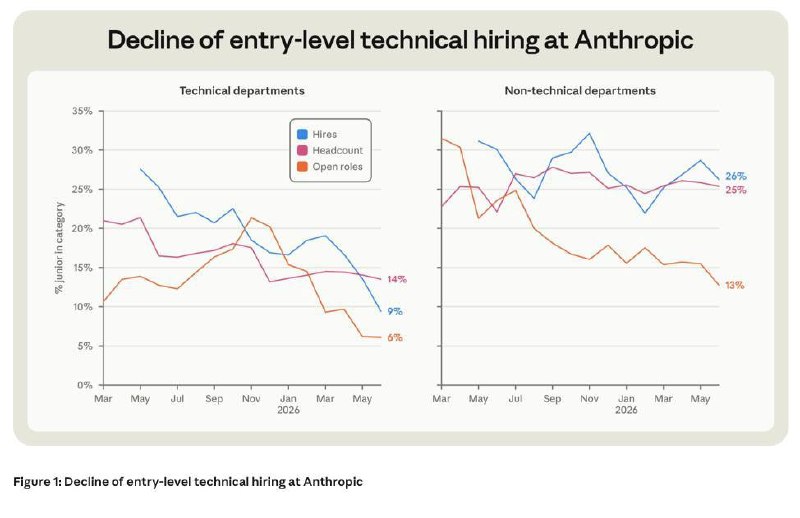
The shift coincides with the widespread deployment of Claude Code throughout Anthropic's software development lifecycle. By August, autonomous coding agents accounted for six times more total work hours than the human engineers overseeing them. Anthropic noted that human supervision is now the primary speed constraint: Claude Code spends approximately 80% of its active execution time waiting for human prompts or review decisions.
What it is
- Junior hiring contraction. The proportion of junior software engineers recruited by Anthropic fell from 27% to 9% following the integration of Claude Code.
- Tripled headcount. Overall corporate headcount tripled over the measured timeframe, showing increased hiring concentration in senior and architecture roles.
- Autonomous agent scale. Claude Code agents completed six times more coding volume by hours than human engineering leads.
- Human latency bottleneck. Anthropic reports that Claude Code spends approximately 80% of total elapsed session time idling while waiting for human input and approvals.
Engineering metrics
| Metric | Prior Period | Post-Claude Code Deployment |
|---|---|---|
| Junior engineer hire share | 27% | 9% |
| Total company headcount | Baseline (1x) | 3x growth |
| Agent vs human work volume | 1x human parity | 6x agent output |
| Claude Code idle wait time | Minimal | 80% waiting on humans |
Sources
Did this land? Leave a reaction.
Discussion
0 commentsMembers can join the discussion
Become a member to comment and reply to other members.
Become a MemberNo comments yet
Be the first to start the discussion.