
Summarize with AI


Anthropic Fellows Jasmine Shone and Lisa Dunlap have published a two-part study showing that individual neuron output vectors in SwiGLU blocks can power practical safety classifiers, steering, and model audits without training auxiliary autoencoders or probes. Both papers and evaluation methodologies are available on Anthropic's Alignment Science Blog.
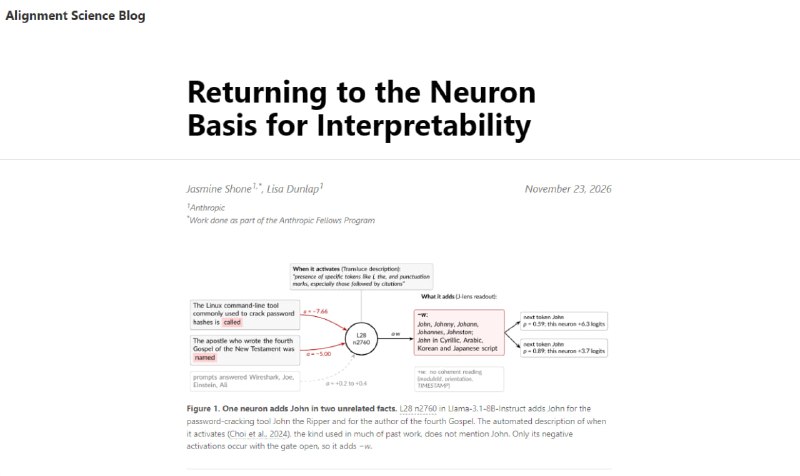
Rather than looking only at what triggers a neuron to fire, the researchers examined the fixed vector each SwiGLU neuron scales and adds to the residual stream, translating those vectors into human-readable concepts through a J-lens vocabulary readout with no extra training.
What it is
- Neuron basis findings: Across Llama-3.1-8B, Qwen3, and OLMo, neurons adding two unrelated concepts made up at most 1% of high-impact directions, transferring output vectors across layers preserved semantics in 91% to 98% of cases, and distributed factual knowledge broke down into individually readable connections.
- Zero-shot harm detection and steering: A harm classifier built from neuron output vectors outperformed text search on 11 of 17 topics in The Pile and matched linear classifiers trained on 400 labeled examples across 4 of 16 test sets. Adding neuron vectors during generation steered WeirdChat responses in 21% of cases, matching trained steering vectors.
- LoRA backdoor audits and unlearning checks: In a blind audit of 68 LoRA adapters with planted backdoors, comparing weight updates with base-model neurons raised detection from 40% to 75% over output-only checks. Across 23 WMDP-cyber checkpoints, 14 kept the highest probability on right answers under cloze scoring, and restoring original weights on just 30 of 460,000 neurons recovered unlearned knowledge.
Sources
Did this land? Leave a reaction.
Discussion
0 commentsMembers can join the discussion
Become a member to comment and reply to other members.
Become a MemberNo comments yet
Be the first to start the discussion.